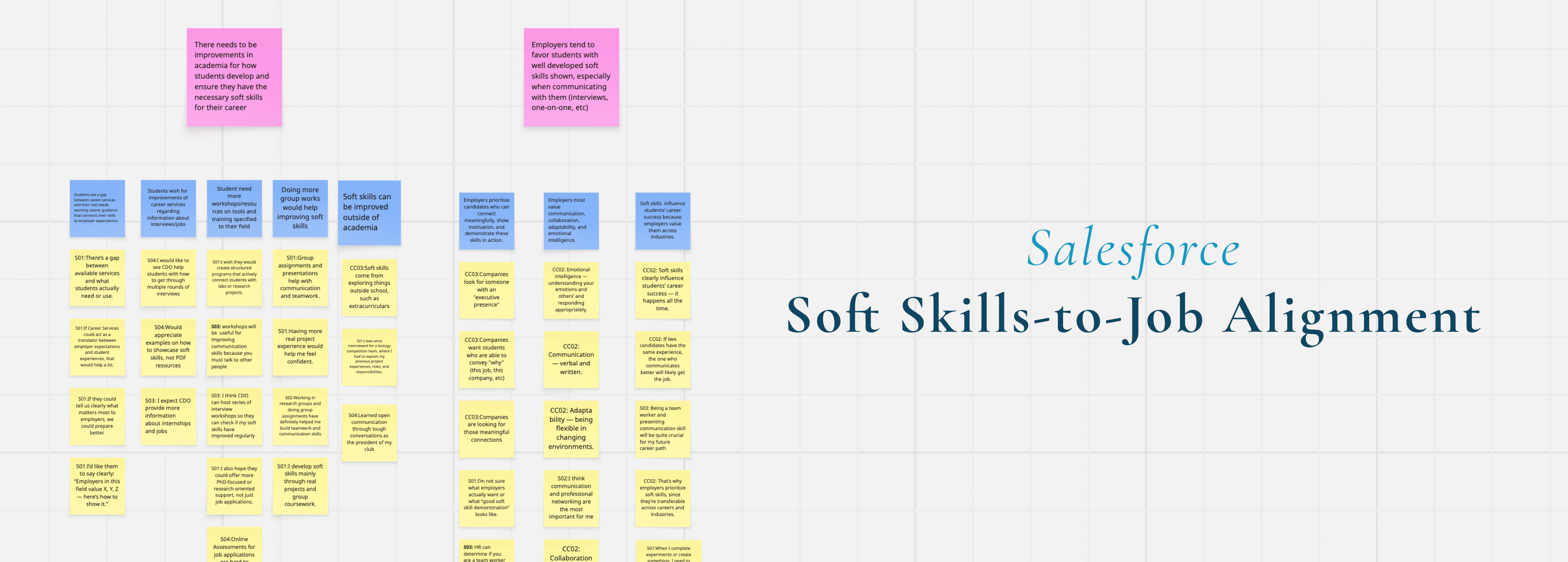
Salesforce: Soft Skills-to-Job Alignment
A research case study exploring the key barriers for university career services in tracking students' soft skills and linking them to in-demand jobs
Role
Lead UX Researcher
Team
4 UX Researchers
Timeline
August 2025 - December 2025
Skills
User Interviews, Affinity Notes, Coding Interviews
Background
For our class, Problem-Solving with People, Information, and Technology (SI 500), we worked with our client, Salesforce, to answer one of three questions they presented to us on the theme of Life-Changing Education:
- What are the core privacy and bias concerns for students using AI-powered education tools, and what are their expectations for data transparency?
- What are the most effective ways to use gamification to improve student engagement and motivation without compromising deep learning or fostering unhealthy competition?
- What are the key barriers for university career services in tracking students' soft skills and linking them to in-demand jobs?
They introduced their demo: Salesforce Education Cloud Platform (now Agentforce Education), which maximizes staff impact institution-wide with common capabilities and a flexible data foundation for lifelong learning.
My team and I decided to explore the third question: Challenges of Skills-to-Job Alignment. Specifically, the key barriers that University Career Services face when it comes to tracking and validating student soft skills needed for career-readiness.
- What are the core privacy and bias concerns for students using AI-powered education tools, and what are their expectations for data transparency?
- What are the most effective ways to use gamification to improve student engagement and motivation without compromising deep learning or fostering unhealthy competition?
- What are the key barriers for university career services in tracking students' soft skills and linking them to in-demand jobs?
They introduced their demo: Salesforce Education Cloud Platform (now Agentforce Education), which maximizes staff impact institution-wide with common capabilities and a flexible data foundation for lifelong learning.
My team and I decided to explore the third question: Challenges of Skills-to-Job Alignment. Specifically, the key barriers that University Career Services face when it comes to tracking and validating student soft skills needed for career-readiness.
STEM students have always focused on building up their technical skills that are relevant to their careers. However, as society becomes more efficient with technology, there is a higher demand for soft skills.

How many qualified STEM students miss opportunities in their careers simply because they can't identify or prove the soft skills they already have, because they only focus on technical skills?
Problem
Based on our prompt, we iterated our How Might We statement over 3 times throughout this process, and eventually finalized on this:
How might we support academic/career services in accurately, efficiently tracking & validating STEM students' most in-demand soft skills for career readiness?
Research Methodology
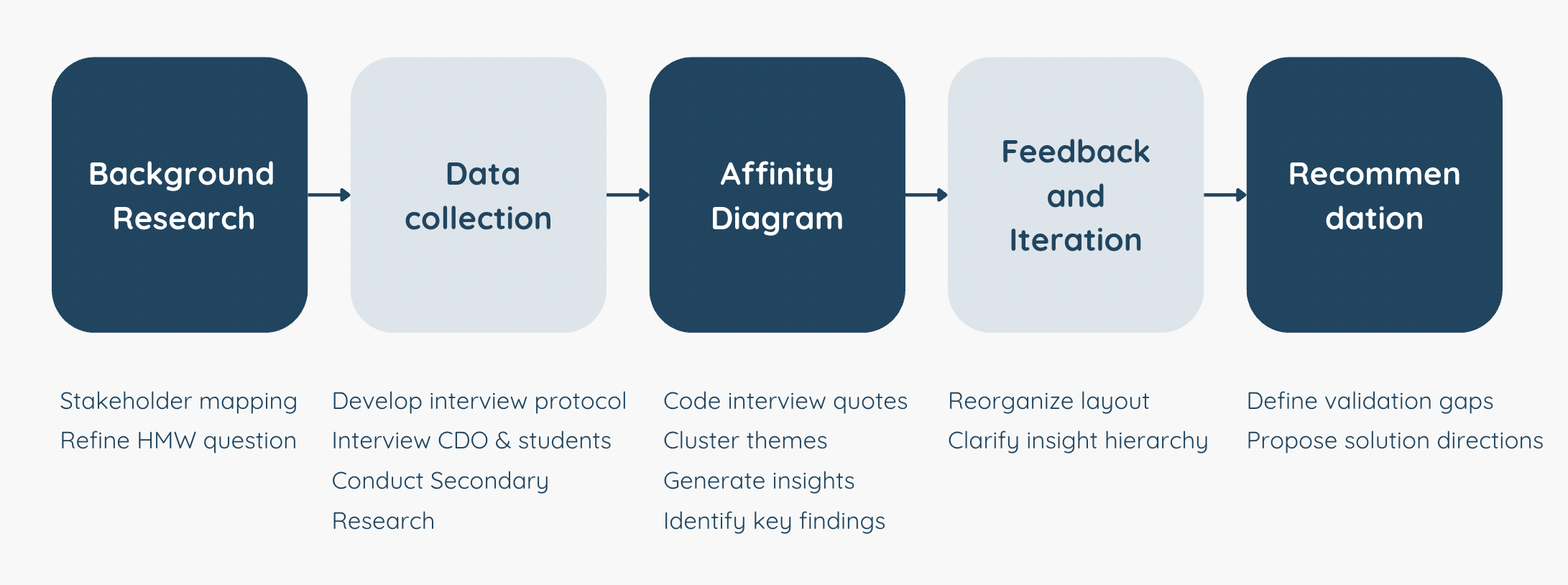
We had an intensive research process consisting of:
Background research —> Data Collection —> Feedback & Iteration –> Recommendations to Stakeholders
Background research —> Data Collection —> Feedback & Iteration –> Recommendations to Stakeholders
Data Collection
Semi-Structured Interviews:
- 3 Career Development Offices: Shared advising workflows, documentation habits, and challenges in identifying & validating soft skills.
- 4 STEM Students: Described how they develop and present soft skills, their interactions with career services, and the support they hope to receive.
Secondary Research:
I did secondary research on HR reports regarding soft skills.
However my team also did secondary research on:
- The Human Factor (Lightcast)
- NACE Research Reports
- AAC&U soft-skills frameworks and rubrics
This allowed us to see broader trends, identify systemic and institutional barriers & provide quantitative indicators not captured through interviews.
- 3 Career Development Offices: Shared advising workflows, documentation habits, and challenges in identifying & validating soft skills.
- 4 STEM Students: Described how they develop and present soft skills, their interactions with career services, and the support they hope to receive.
Secondary Research:
I did secondary research on HR reports regarding soft skills.
However my team also did secondary research on:
- The Human Factor (Lightcast)
- NACE Research Reports
- AAC&U soft-skills frameworks and rubrics
This allowed us to see broader trends, identify systemic and institutional barriers & provide quantitative indicators not captured through interviews.
Affinity Wall
.jpg)
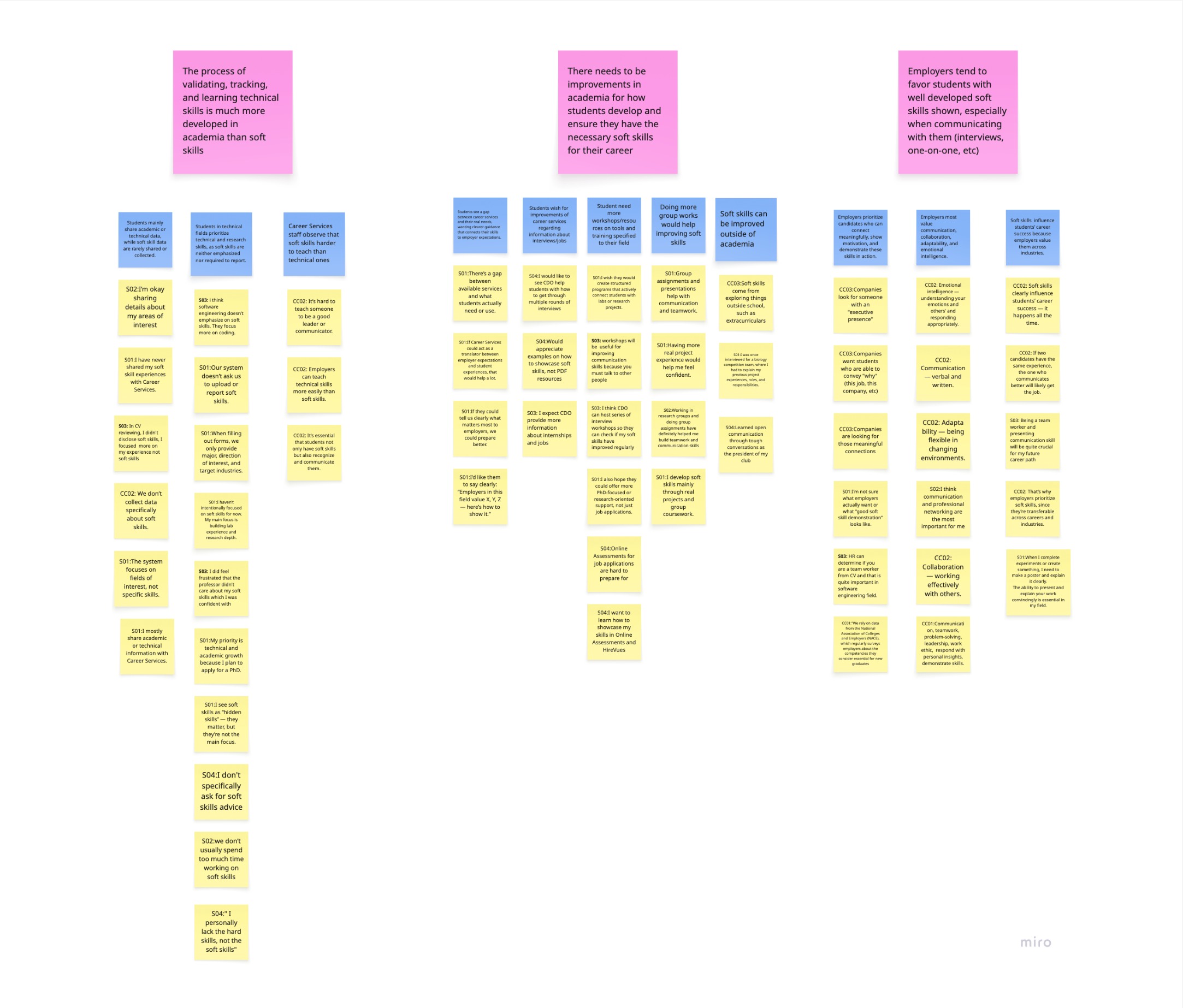
We transformed raw interview transcripts into individual sticky notes—yellow for direct quotes, blue for first-level themes, and pink for synthesized second-level insights.
Through multiple rounds of team clustering and discussion, we organized these notes into emerging themes:
Through multiple rounds of team clustering and discussion, we organized these notes into emerging themes:
1) Technical-skill validation systems are far more mature than soft-skill systems in academia.
2) Students lack structured pathways to develop or evidence soft skills.
3) Employers highly value demonstrated soft skills during communication-based interactions.
4) Career services provide many programs, but inconsistent or unclear advice may undermine student confidence.
5) Current validation relies heavily on qualitative interactions; students desire more concrete proof.
6) Existing validation tools are available but underutilized or misaligned with academic structures.
Key Insights From Research
Based on our research process and methodology, we identified three main findings that reveal critical gaps in how soft skills are developed, validated, and communicated between students, career services, and employers. These findings are:
Key Finding 01: Career Services Gap
Career services actively provide a variety of programs— such as workshops, one-on-one coaching sessions, resume review but sometimes harm students' confidence due to lack of understanding or unclear advice.
Career services actively provide a variety of programs— such as workshops, one-on-one coaching sessions, resume review but sometimes harm students' confidence due to lack of understanding or unclear advice.
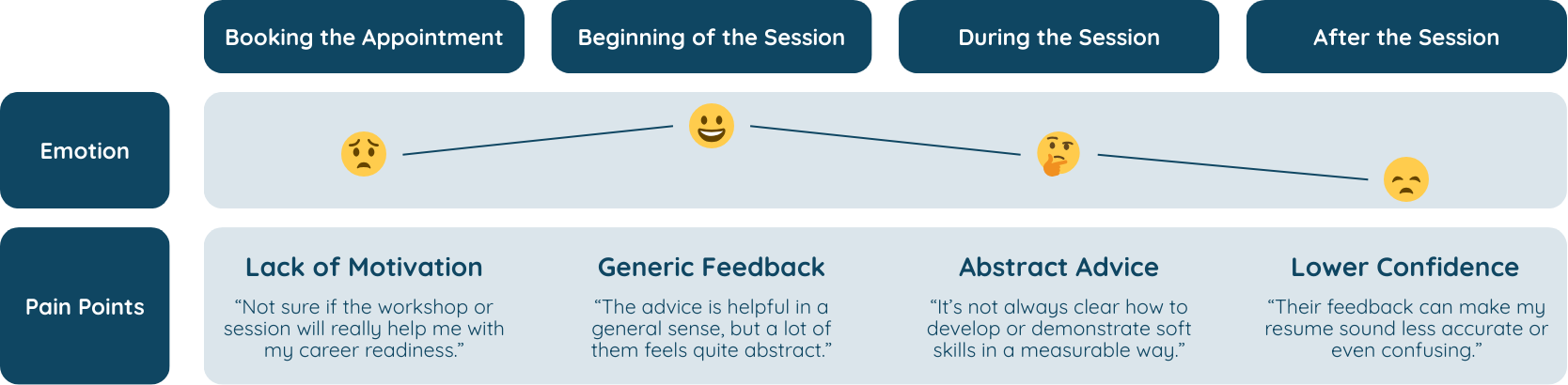
Career services already have the infrastructure (workshops, advising sessions, resources), and students are actively seeking this support.
The opportunity lies in refining how advice is delivered to be more personalized, field-specific, and actionable. Students aren't asking for more services; they're asking for better-targeted support that connects directly to their goals and experiences.
The opportunity lies in refining how advice is delivered to be more personalized, field-specific, and actionable. Students aren't asking for more services; they're asking for better-targeted support that connects directly to their goals and experiences.
Key Finding 02: Soft Skills That Are Prioritized by Employers, but Not as Much by STEM students
Out of all the soft skills, employers tend to favor students who demonstrate willingness to learn, strong work ethic, clear communication, and teamwork.
Out of all the soft skills, employers tend to favor students who demonstrate willingness to learn, strong work ethic, clear communication, and teamwork.
.png)
Employers consistently favor students demonstrating the skills above, however while interviewing, we discovered a significant disconnect: STEM students often don't recognize soft skills as a priority in their education or career preparation.
This gap creates a cycle —> Students underinvest in soft skills because their academic programs don't emphasize them, while employers struggle to find candidates with these exact capabilities. The mismatch isn't about ability, but about awareness and prioritization.
Students are capable of developing strong soft skills, but without explicit validation or recognition systems, they don't see the value in actively cultivating them.
This gap creates a cycle —> Students underinvest in soft skills because their academic programs don't emphasize them, while employers struggle to find candidates with these exact capabilities. The mismatch isn't about ability, but about awareness and prioritization.
Students are capable of developing strong soft skills, but without explicit validation or recognition systems, they don't see the value in actively cultivating them.
Key Finding 03: Students Want Further Proof of Soft-Skill Growth
Soft skills are currently being validated through different kinds of qualitative interactions, but students want more proof of validation.
Soft skills are currently being validated through different kinds of qualitative interactions, but students want more proof of validation.
.png)
Students want validation that is structured and credible; something they can point to as concrete evidence of their capabilities. They're actively seeking endorsements from people who have directly observed their work:
- S02: "Ideally, I'd like to have professors or PhD students I've worked with vouch for me."
- S03: "I sought advice and feedback for my communication skills from my ex-colleague as a form of validation."
- S02: "Ideally, I'd like to have professors or PhD students I've worked with vouch for me."
- S03: "I sought advice and feedback for my communication skills from my ex-colleague as a form of validation."
Recommendations to implement for Education Cloud
Our team came up with three design possible solutions for Salesforce:
01: Gamified Soft Skills Development System with Digital Badges
- The system will offer students a series of gamified challenges, tasks, and workshops that can be completed in real-life situations on a daily basis, from organizing project plans to collaborating with classmates from different professional backgrounds.
- When students complete these tasks, they need to submit traceable evidence, such as presentation videos, teammate evaluations, or task outcome documents, and they will recieve a digital badge to recognize their skill.
02: Job Matching & Alignment
- A feature where the student is able to add in the link of the job they want to apply to from any platform (LinkedIn, Handshake, etc) into the Education Cloud. Then they are able to have a comparison done between the resume they submitted and the notes taken from career services about their soft skills and see if their skills align with the job.
- However, the obvious drawback of this function is that it cannot truly verify whether students have this skill, as it is all written by the students themselves
03: Soft Skill Profile Builder
- A multi-source validation system that provides strong credibility for soft skills through the endorsement of recommenders. For example, students can ask professors or PhDs they have worked with to prove that they confirm this student has this specific skill.
- However, this plan is highly dependent on students' previous experience and only takes effect when students have sufficient project experience and social resources
01: Gamified Soft Skills Development System with Digital Badges
- The system will offer students a series of gamified challenges, tasks, and workshops that can be completed in real-life situations on a daily basis, from organizing project plans to collaborating with classmates from different professional backgrounds.
- When students complete these tasks, they need to submit traceable evidence, such as presentation videos, teammate evaluations, or task outcome documents, and they will recieve a digital badge to recognize their skill.
02: Job Matching & Alignment
- A feature where the student is able to add in the link of the job they want to apply to from any platform (LinkedIn, Handshake, etc) into the Education Cloud. Then they are able to have a comparison done between the resume they submitted and the notes taken from career services about their soft skills and see if their skills align with the job.
- However, the obvious drawback of this function is that it cannot truly verify whether students have this skill, as it is all written by the students themselves
03: Soft Skill Profile Builder
- A multi-source validation system that provides strong credibility for soft skills through the endorsement of recommenders. For example, students can ask professors or PhDs they have worked with to prove that they confirm this student has this specific skill.
- However, this plan is highly dependent on students' previous experience and only takes effect when students have sufficient project experience and social resources
.png)
Out of the three, the digital badge system (01) fulfills all the needs of the users.
It starts from the perspective of students' habits and actions, making soft skills into daily executable tasks. Through immediate feedback and behavioral evidence, it makes growth itself visible, measurable, and recognizable.
From the perspectives of systems and career guidance, the digital badge mechanism can help address the problems of soft skills being difficult to track and hard to validate.
It starts from the perspective of students' habits and actions, making soft skills into daily executable tasks. Through immediate feedback and behavioral evidence, it makes growth itself visible, measurable, and recognizable.
From the perspectives of systems and career guidance, the digital badge mechanism can help address the problems of soft skills being difficult to track and hard to validate.
Reflection
My experience throughout this process was life-changing (just like this year's theme).
1) My team was selected as 1 of 2 teams to present in front of 200+ people! We were selected due to our captivating story about a STEM student who almost missed at opportunity due to the lack of emphasis on soft skills. We worked very hard throughout this process, so my team and I were happy to be able to represent our class and present our findings to students, professors, and other companies.
1) My team was selected as 1 of 2 teams to present in front of 200+ people! We were selected due to our captivating story about a STEM student who almost missed at opportunity due to the lack of emphasis on soft skills. We worked very hard throughout this process, so my team and I were happy to be able to represent our class and present our findings to students, professors, and other companies.
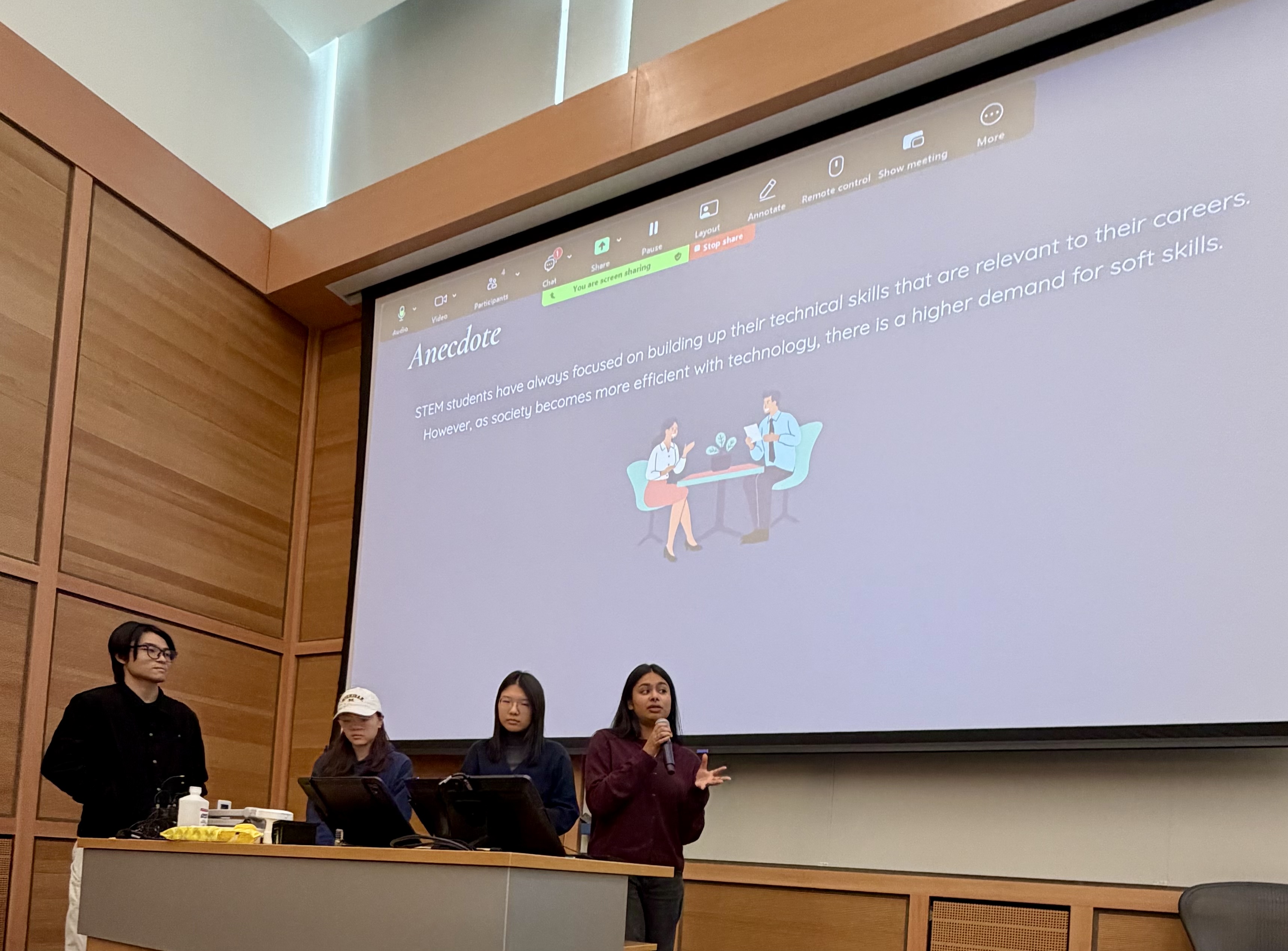
Me opening up our presentation with an insightful antedote about the STEM student alongside my team!
2) I learned a lot about teamwork and the UX process throughout this project:
- Teamwork not only requires strong communication, but vulnerability & trust in one another. My team and I were able to build up this trust in the side conversions we had during our weekly meetings. Although these conversations seemed small, they made a significant impact in building a strong foundation for us to give eachother criticism and make decisions we thought were best for this project together. Our professor also led trust-building exercises during lectures, which allowed us to learn to be vulnerable with our group members and connect on a deeper level— beyond just group members in a project, but as people.
- At the end of my first user interview, my participant told me that I was a "fantastic interviewer", and made them feel comfortable throughout the process. It was very easy to get imposter syndrome throughout this process, but my participant complimenting me on my abilities as an interviewer made me feel more confident in my UX research skills.
- Teamwork not only requires strong communication, but vulnerability & trust in one another. My team and I were able to build up this trust in the side conversions we had during our weekly meetings. Although these conversations seemed small, they made a significant impact in building a strong foundation for us to give eachother criticism and make decisions we thought were best for this project together. Our professor also led trust-building exercises during lectures, which allowed us to learn to be vulnerable with our group members and connect on a deeper level— beyond just group members in a project, but as people.
- At the end of my first user interview, my participant told me that I was a "fantastic interviewer", and made them feel comfortable throughout the process. It was very easy to get imposter syndrome throughout this process, but my participant complimenting me on my abilities as an interviewer made me feel more confident in my UX research skills.
3) If I had more time to this project a step further, I would want to curate user personas, do more user interviews with a wider range of stakeholders (HR, employers, etc), and design the Gamified Soft Skills Digital Badge system.
See my other work!